REVIEW · PARIS
Quad City Tour Paris
Book on GetYourGuide →Operated by quadcitytourparis · Bookable on GetYourGuide
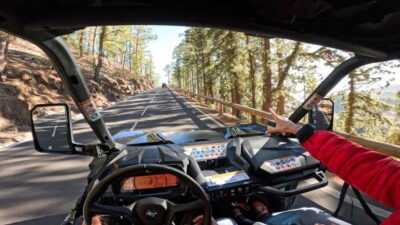
Paris on a quad feels wildly different.
This tour is built for motion: 100% electric quad bikes, a safety-focused guide, and routes chosen for easy sightseeing photos without getting stuck in monument lectures. I especially like that it is small-group friendly (up to 6) and that the guide helps you feel comfortable fast, including snapping great photos. The one catch to think about: you’re riding on a set route and moving continuously, so it is not the option if you want long stops for deep historical explanations.
For me, the biggest win is timing. You can do the Eiffel area, the Louvre/Notre-Dame zone, or Montmartre, and each has both day and evening departure times. I also appreciate the human touch from the guide—Patrick, in the reviews, comes up as friendly, professional, and very good at putting people at ease.
If you’re traveling with a practical mindset and want a fun way to see major sights from street level, this can be a great use of time. Just be aware it is not suitable for everyone (age limits apply, and it’s not designed for hearing-impaired participants), and you will need an ID plus a credit or debit card for a €650 deposit hold.
In This Review
- Key highlights at a glance
- Why Paris Looks Different on a Quiet Electric Quad
- Safety First: Helmets, Gloves, and a Guide in Yellow
- Route Breakdown by Time: Eiffel, Louvre/Notre-Dame, and Montmartre
- Monday
- Wednesday, Thursday, Friday
- Saturday
- Sunday
- Eiffel Tower Run: Avenue Montaigne to the Arc de Triomphe
- Louvre and Notre-Dame at Street Level: Place Vendôme to Concorde
- Montmartre, Pigalle, Moulin Rouge, and Sacré-Cœur: The Night-Friendly Loop
- The Pace, Photo Stops, and How to Get Great Shots
- Electric Quad Value: How $88 for Up to Two Makes Sense
- Who This Quad Tour Fits Best (and Who Should Skip It)
- Should You Book Quad City Tour Paris?
- FAQ
- FAQ
- How long is the Quad City Tour Paris?
- Is the quad bike electric?
- Do I need a driver’s license to ride?
- Where do I meet the guide?
- What’s included in the tour?
- What do I need to bring?
- Are baby strollers or bare feet allowed?
Key highlights at a glance
- 100% electric quads with a quieter ride and easy handling for the road
- No license required for drivers age 16+
- Small groups (max 6) so you are not lost in a crowd
- Day or night options across three popular Paris areas
- Helmet, hair net, and gloves included for a more comfortable ride
- Photo-friendly route planning where you can actually capture the view
Why Paris Looks Different on a Quiet Electric Quad
Paris is famous for walking tours. This experience swaps your shoes for handlebars. The quads are electric, which changes the vibe immediately: less noise, less fumes, and a ride that feels smooth and modern compared with most sightseeing on a busy street.
What you trade is the typical rhythm of pausing and reading plaques. What you gain is flow. Instead of spending your time waiting for the next stop, you get to cover distance and keep your camera ready. The tour’s pitch is simple: you enjoy the surroundings as you ride, without dwelling on every monument.
Two things make this work well for real people. First, the guide is there for safety and guidance, not just as a person holding a microphone. Second, the tour is structured so you hit recognizable Paris landmarks in a short window, which matters if you only have a day (or half a day) in the city.
One more detail I like: the experience is aimed at capturing souvenir photos. You will still see the big famous places, but the pacing is set for you to remember how the streets felt, not just what the stones are called.
Safety First: Helmets, Gloves, and a Guide in Yellow

Before you ride, you get geared up. Helmets, hair nets, and gloves are provided. That combo is more than a box-check—gloves in particular make the ride easier on your hands, especially if it’s cooler or you are focused on steering.
The meeting point is in front of ZARA, and you report to the guide wearing a yellow vest. It’s straightforward, and it helps if you are arriving a bit early—just look for the bright vest and the group.
Also know the rules up front so nothing surprises you mid-tour:
- You must bring ID (required) and a credit or debit card for the €650 deposit hold.
- The card hold is not described as a payment, and it is canceled at the end of the tour.
- You cannot bring baby strollers, and you must avoid alcohol and drugs.
- Bare feet are not allowed.
The deposit requirement is the main thing to plan for. You don’t want to show up with only cash or a card you’re unsure will work for a hold. If you can handle that, everything else feels pretty standard.
Route Breakdown by Time: Eiffel, Louvre/Notre-Dame, and Montmartre

Quad City Tour Paris runs multiple departure times each week, and the route changes depending on the day and whether it’s day or night. Each itinerary is built around a recognizable Paris “circle” of streets and landmarks, so you end up with a set of photos that look like you planned them.
Here’s how the day-by-day structure shakes out:
Monday
- 5:20 p.m. and 8:20 p.m.: Eiffel Tower route
You start at Avenue Montaigne and roll through Pont de l’Alma, the Eiffel area, Les Invalides, Pont Alexandre III, Grand and Petit Palais, Champs-Élysées, and Arc de Triomphe.
Wednesday, Thursday, Friday
- 4:50 p.m.: Louvre / Notre-Dame route
Place Vendôme → Opéra Garnier → Louvre → Hôtel de Ville → Notre-Dame → Place de la Concorde.
- 6:50 p.m.: Montmartre route
Pigalle → Moulin Rouge → Sacré Coeur → Place de Clichy.
- 8:50 p.m.: Eiffel Tower route
Same Eiffel route as Monday.
Saturday
- 12:50 p.m.: Louvre / Notre-Dame route
- 5:50 p.m.: Montmartre route
- 7:50 p.m. and 9:50 p.m.: Eiffel Tower route
Sunday
- 5:50 p.m.: Louvre / Notre-Dame route
- 7:50 p.m.: Montmartre route
- 8:20 p.m.: Eiffel Tower route
Why this matters: if you’re the kind of traveler who likes your photos to match the light, evening rides are a real advantage. The tour is explicitly set up for both day and night, and the Eiffel, Champs-Élysées, and major crossings are exactly the kinds of places that change the mood after dark.
Eiffel Tower Run: Avenue Montaigne to the Arc de Triomphe
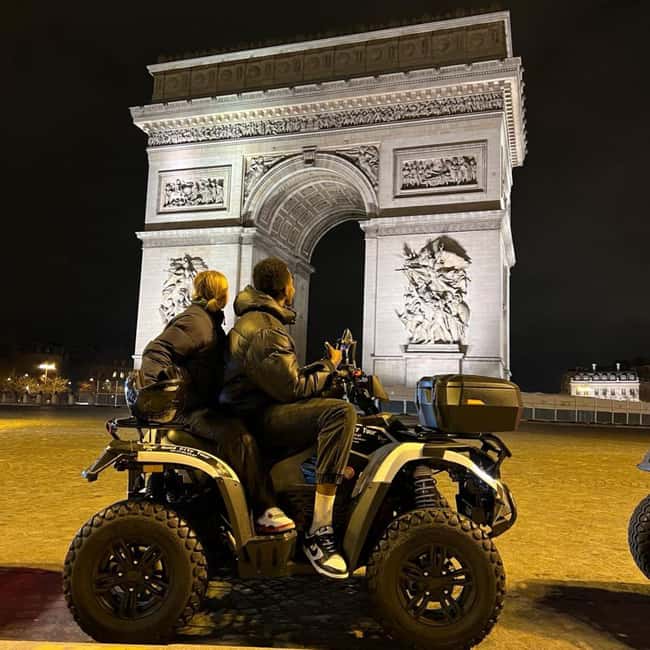
If you want a single “Paris signature” loop, the Eiffel route is the one. It passes through the kind of central streets people picture when they think of Paris, and it also strings together a few areas that feel different from each other.
The run includes:
- Avenue Montaigne
- Pont de l’Alma
- Eiffel Tower
- Les Invalides
- Pont Alexandre III
- Grand and Petit Palais
- Champs-Élysées
- Arc de Triomphe
What makes this special is the variety within one ride. You get the Eiffel area, then you move to bridges and grand boulevards, then finish with the Arc de Triomphe. Even if you don’t stop for a long time, the route gives you a spread of recognizable city scenes.
Day vs. night is where this route shines. During the day, you get crisp street-level sightlines. In the evening, you’re more likely to get the “Paris lights” feeling simply because of where the route travels and the time it runs (especially the late departures).
A small practical tip: because the tour is 90 minutes total, keep your camera accessible. Don’t wait until the last second to pull it out, especially when you’re aiming for souvenir shots.
Louvre and Notre-Dame at Street Level: Place Vendôme to Concorde
This route is ideal if you want a classic Paris combo: refined shopping streets, opera-area architecture, and two of the most iconic landmark names in the city—Louvre and Notre-Dame.
The itinerary includes:
- Place Vendôme
- Opéra Garnier
- The Louvre
- Hôtel de Ville
- Notre Dame
- Place de la Concorde
What I like about this mix is that it feels like “Paris in layers.” You start in a polished area (Place Vendôme), then the route moves through the Opéra Garnier zone, reaches the Louvre area, and then transitions toward Notre-Dame and Place de la Concorde.
Is it for everyone? Yes, if you want big-name sights inside one compact schedule. But if you’re the kind of traveler who expects museum-style pacing or long commentary at each stop, you may find it more focused on riding and quick photo moments. The experience is designed to move, and you’re not hanging around a single location for extended time.
Also, because the route is timed for both afternoon and evening departures (like the Saturday 12:50 p.m. slot, and multiple evening options), you can pick the energy you prefer—early-day brightness or late-day ambiance.
Montmartre, Pigalle, Moulin Rouge, and Sacré-Cœur: The Night-Friendly Loop
Montmartre is a different mood from central Paris, and this route leans into that. It’s one of the most fun areas to see when you want something more dramatic and photogenic.
This itinerary includes:
- Pigale
- Moulin Rouge
- Sacré Coeur
- Place de Clichy
You get a path that runs through recognizable names, including the Moulin Rouge area, and ends with Place de Clichy. The “value” here is not just sight value—it’s the shift in street character. Even without a long stop, riding through this cluster of landmarks gives you a sense of the neighborhood’s vibe that you would have to work much harder to recreate on foot.
If you’re choosing between Montmartre and the Eiffel loop, think about what you want your photos to feel like. Eiffel routes give you big postcard Paris energy. Montmartre gives you more atmosphere and personality.
The Pace, Photo Stops, and How to Get Great Shots
The tour’s whole method is fast and photo-focused. People often say it is quick but fun, and that matches what this kind of riding tour feels like. You will spend most of the 90 minutes actually on the quad, moving through the route and getting windows for pictures.
A good way to approach this: treat the tour like a guided photo walk where you’re going faster than walking. You’re not just looking—you’re steering. That means your best results come from being ready.
From what I’ve learned about the experience, the guide can also be a helpful photo ally. In the reviews, Patrick is highlighted as a friendly, professional guide and even a strong photographer. If you want cleaner souvenir shots, don’t be shy about asking when it’s a good moment to pose, where to stand, or how to frame the landmark as you approach it.
One more practical angle: because you’re wearing helmet and gloves, you may feel a bit stiff at first. That’s normal. Give yourself the first few minutes to settle. After that, the experience usually clicks into a rhythm.
Electric Quad Value: How $88 for Up to Two Makes Sense
The price is listed at $88 per group up to 2, and the time is 90 minutes. That pricing structure can be a big deal if you’re traveling with a partner or friend who is willing to ride with you.
Here’s how I think about the value:
- You’re paying for access to a powered sightseeing experience, not just a guide walking next to you.
- You get the equipment (helmets, hair nets, gloves), so you’re not guessing what to bring.
- You’re covering a route that links multiple major landmarks, which saves time versus piecing together separate transport legs.
The main “hidden cost” is not the money—it’s the mental checklist. You need ID, you need a card for the deposit hold, and you need to match the driving rules (age 16+ for drivers). If you meet those, the price feels fair for the amount of ground you cover and the uniqueness of riding an electric quad through central areas.
If you’re solo and hoping for a private experience, the small-group limit (up to 6) matters. You’re not getting privacy, but you are getting a tighter group than big bus tours.
Who This Quad Tour Fits Best (and Who Should Skip It)
This tour is built for people who want movement and photos, not people who want long stops and heavy narration.
It suits you if:
- You like day trips that are more active than walking.
- You want to see the Eiffel area, the Louvre/Notre-Dame zone, or Montmartre without planning complicated transport.
- You’re comfortable following safety instructions and staying with the group.
- You’re traveling in a small pair, which fits the group pricing model.
It’s not right for you if:
- You need accessibility accommodations not covered by the tour (hearing-impaired people are listed as not suitable).
- You don’t meet the age rules: drivers must be 16+, and the tour is not suitable for children under 7. People over 70 are listed as not suitable.
- You want to bring strollers or you plan on riding without shoes.
One last point: alcohol and drugs are not allowed. If you’re thinking of combining nightlife plans with the quad ride, keep it responsible so you can enjoy the experience without losing focus.
Should You Book Quad City Tour Paris?
If your goal is to see major sights in a compact time window and you want a fun, modern way to do it, I’d say this is worth considering. The best reason to book is the combination of electric quads, small group size, and the option to ride either day or night across three strong Paris areas.
Choose this tour if you want postcard landmarks plus a street-level feel, delivered in about 90 minutes. Skip it if you want museum-grade pacing, quiet time, or extended stops for deep historical commentary—this ride is about motion and photos.
If you can bring your ID and a credit/debit card for the €650 deposit hold, and you’re within the age and suitability limits, you’ll likely leave with more than just a list of sights. You’ll have the kind of souvenir photos that look like you actually experienced the city, not just scheduled it.
FAQ
FAQ
How long is the Quad City Tour Paris?
The tour lasts 90 minutes.
Is the quad bike electric?
Yes. The quads are 100% electric.
Do I need a driver’s license to ride?
No license is needed. Anyone over 16 can drive the quad.
Where do I meet the guide?
Meet in front of the ZARA store and look for the guide wearing a yellow vest.
What’s included in the tour?
Helmets, hair nets, and gloves are provided.
What do I need to bring?
Bring an ID and a credit or debit card for a €650 deposit hold.
Are baby strollers or bare feet allowed?
No. Baby strollers are not allowed, and bare feet are also not allowed.